
Pages: 1072
ISBN: 9780813125657
Pub Date: December 2009
Imprint: University Press of Kentucky
Illustrations: 182 illustrations
Price:
£27.00
This book will be reprinted and your order will be released in due course.
Pages: 1072
ISBN: 9780813125855
Pub Date: December 2009
Imprint: University Press of Kentucky
Illustrations: 182
Price:
£45.00
In stock
You will be redirected to our distribution partners, Pen & Sword Books, to complete your purchase.
Description:
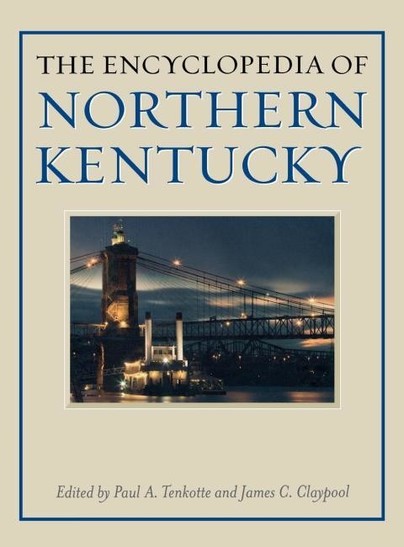
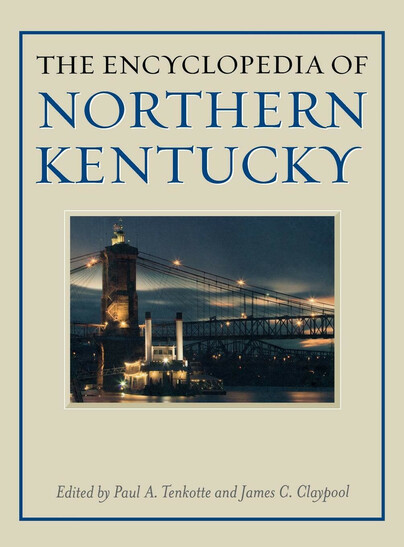
The Encyclopedia of Northern Kentucky is the authoritative reference on the people, places, history, and rich heritage of the Northern Kentucky region. The encyclopedia defines an overlooked region of more than 450,000 residents and celebrates its contributions to agriculture, art, architecture, commerce, education, entertainment, literature, medicine, military, science, and sports. Often referred to as one of the points of the "Golden Triangle" because of its proximity to Lexington and Louisville, Northern Kentucky is made up of eleven counties along the Ohio River: Boone, Bracken, Campbell, Carroll, Gallatin, Grant, Kenton, Mason, Owen, Pendleton, and Robertson. With more than 2,000 entries, 170 images, and 13 maps, this encyclopedia will help readers appreciate the region's unique history and culture, as well as the role of Northern Kentucky in the larger history of the Commonwealth of Kentucky and the nation. Describes the "Golden Triangle" of Kentucky, an economically prosperous area with high employment, investment, and job-creation rates Contains entries on institutions of higher learning, including Northern Kentucky University, Thomas More College, and three community and technical colleges Details the historic cities of Covington, Newport, Bellevue, Dayton, and Ludlow and their renaissance along the shore of the Ohio River Illustrates the importance of the Cincinnati / Northern Kentucky International Airport as well as major corporations such as Ashland, Fidelity Investments, Omnicare, Toyota North America, and United States Playing Card
When Heinz Lüning posed as a Jewish refugee to spy for Hitler's Abwehr espionage agency, he thought he had discovered the perfect solution to his most pressing problem: how to avoid being drafted into Hitler's army. Lüning was unsympathetic to Fascist ideology, but the Nazis' tight control over exit visas gave him no chance to escape Germany. He could enter Hitler's army either as a soldier... or a spy. In 1941, he entered the Abwehr academy for spy training and was given the code name "Lumann." Soon after, Lüning began the service in Cuba that led to his ultimate fate of being the only German spy executed in Latin America during World War II. Lüning was not the only spy operating in Cuba at the time. Various Allied spies labored in Havana; the FBI controlled eighteen Special Intelligence Service operatives, and the British counterintelligence section subchief Graham Greene supervised Secret Intelligence Service agents; and Ernest Hemingway's private agents supplied inflated and inaccurate information about submarines and spies to the U.S. ambassador, Spruille Braden. Lüning stumbled into this milieu of heightened suspicion and intrigue. Poorly trained and awkward at his work, he gathered little information worth reporting, was unable to build a working radio and improperly mixed the formulas for his secret inks. Lüning eventually was discovered by British postal censors and unwittingly provided the inspiration for Graham Greene's Our Man in Havana. In chronicling Lüning's unlikely trajectory from a troubled life in Germany to a Caribbean firing squad, Thomas D. Schoonover makes brilliant use of untapped documentary sources to reveal the workings of the famed Abwehr and the technical and social aspects of Lüning's spycraft. Using archival sources from three continents, Schoonover offers a narrative rich in atmospheric details to reveal the political upheavals of the time, not only tracking Lüning's activities but also explaining the broader trends in the region and in local counterespionage. Schoonover argues that ambitious Cuban and U.S. officials turned Lüning's capture into a grand victory. For at least five months after Lüning's arrest, U.S. and Cuban leaders -- J. Edgar Hoover, Fulgencio Batista, Nelson Rockefeller, General Manuel Benítez, Ambassador Spruille Braden, and others -- treated Lüning as a dangerous, key figure for a Nazi espionage network in the Gulf-Caribbean. They reworked his image from low-level bumbler to master spy, using his capture for their own political gain. In the sixty years since Lüning's execution, very little has been written about Nazi espionage in Latin America, partly due to the reticence of the U.S. government. Revealing these new historical sources for the first time, Schoonover tells a gripping story of Lüning's life and capture, suggesting that Lüning was everyone's man in Havana but his own.