
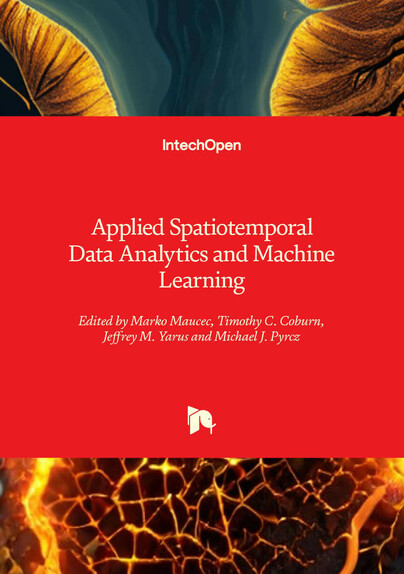
Format: Hardback
Pages: 504
ISBN: 9781839685019
Pub Date: April 2026
Imprint: IntechOpen
Price:
£159.00
This book will be reprinted and your order will be released in due course.
You will be redirected to our distribution partners, Pen & Sword Books, to complete your purchase.
Description:
This book is an edited volume presenting current principles, methods, and case studies in spatiotemporal data analytics for beginning to intermediate practitioners. It emphasizes practical workflows drawn from multiple disciplines and is intended as a guide for readers seeking to better understand the tools, technologies, and decision-making processes involved in building spatial and spatiotemporal models that incorporate both statistical and machine-learning approaches.The volume is not a textbook on the mathematical foundations of spatial or temporal modeling, nor does it attempt a comprehensive review of theoretical development. Instead, it focuses on practical insight—explaining and demonstrating why particular approaches are used, how they are implemented, and where their limitations lie. Contributions span petroleum and mining, environmental geoscience, tectonics, geothermal systems, forestry, and power-grid analysis, reflecting the broad applicability of spatiotemporal analytics across scientific and engineering domains.A dedicated section of the book addresses geoinformatics and the integrated use of widely adopted scripting languages, such as Python and R, in modern spatiotemporal and geostatistical workflows. System configurations and code examples illustrate data aggregation, analysis, simulation, and management in reproducible, transparent environments. Most chapters intentionally rely on open-source tools, with workflows shown in full to encourage accessibility and to promote a 'check-the-code” approach to skill development.Readers should be able to follow the examples and adapt the demonstrated workflows to their own projects. The aim of the book is not to produce experts, but to provide an introduction—or a practical boost—to the concepts, language, and coding practices that support effective collaboration with computer scientists, data scientists, and fellow modelers. While additional material could have been included, the chapters are deliberately concise, encouraging readers to engage more deeply with the extensive literature cited throughout the volume.