Format: Paperback
Pages: 224
ISBN: 9798888572290
Pub Date: October 2025
Imprint: Oxbow Books
Illustrations: 150 colour illustrations
Price:
£24.95
In stock
You will be redirected to our distribution partners, Pen & Sword Books, to complete your purchase.
Description:
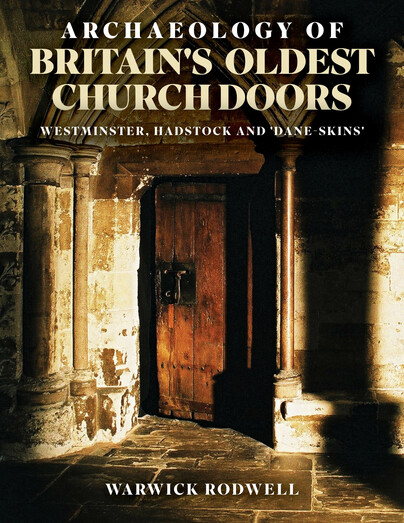
Archaeology of Britain’s Oldest Church Doors presents a detailed and fascinating study of the two oldest doors in England: in the chapter house vestibule at Westminster Abbey, which pre-dates the Norman Conquest (1050s) and the north nave door at Hadstock Church, Essex, dated to the 1060s–70s. The Westminster door was formerly covered with skin on both faces, which had been claimed as human, and variously attributed either to a Danish raider, or to the English merchant who instigated an audacious robbery in 1303 from the royal treasury, housed in the abbey cloister. The Hadstock door was notorious for its presumed great antiquity and the fact that its exterior had also once been covered with hide. Moreover, these doors were embellished with ornate ironwork.Having been responsible for archaeological investigations that involved both of these doors and their settings at Westminster and Hadstock, in this book Warwick Rodwell has brought them together, along with evidence from other early, particularly hide-covered, doors. At these and other locations in England, the assertion was that the remains of hides on church doors were human, and mostly attributed to pillaging Danes. The arguments for why this gruesome claim could not be true are explored and scientific investigations presented in order to separate fact from fiction.Yet this book is concerned with more than just the hides. It considers the form and construction of the earliest surviving English doors. The application of dendrochronology made it possible to date the oak boards from which church doors were constructed. Architectural and archaeological evidence pointed to three doors as potential claimants for the status of being the oldest in Britain and dendrochronology ranked them in date order: Westminster Abbey, 1050s; Hadstock Church, 1060s–70s; and Rochester Cathedral, c. 1080s–90s. All three doors are still in daily use in their respective buildings.A surprising variety of techniques is displayed in the later 11th and 12th centuries, and the Westminster door is unique. Its form of construction is unmatched by any other recorded door in Britain. Are its origins Anglo-Saxon or Norman-French? Two woodwork historians, Peter Massey and Paul Reed, undertook a detailed study of the construction method and tools required to fabricate the Westminster door, and a chapter has been devoted here to their findings.