
Format: Hardback
Pages: 428
ISBN: 9781836355397
Pub Date: June 2026
Imprint: IntechOpen
Price:
£139.00
This book will be reprinted and your order will be released in due course.
You will be redirected to our distribution partners, Pen & Sword Books, to complete your purchase.
Description:
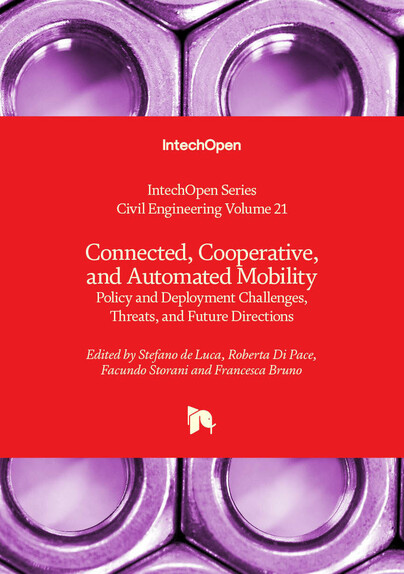
The book aims to analyze, develop, and validate approaches, methodological tools, and procedures for testing Cooperative, Connected, and Automated Mobility (CCAM). It brings together contributions that present innovative control and analytical methods based on next-generation intelligent transportation systems, with the aim of advancing scientific and technological knowledge and providing methodological support to stakeholders involved in defining strategies, technical standards, and guidelines for future mobility. The volume integrates both review and methodological contributions, focusing on traffic optimization strategies, technological solutions, analytical frameworks, safety and security issues, and future market perspectives. It also includes assessments of the potential positive and negative impacts on transport system performance, environmental sustainability, safety, and equity. The book is structured into four interconnected sections, each addressing a key dimension of the evolving ecosystem of connected, cooperative, and automated mobility. Section I focuses on frameworks and strategy issues and brings together contributions that define roadmaps, governance models, and policy directions. Section II investigated security and resilience issues, exploring the cybersecurity threats, system vulnerabilities, and resilience strategies to safeguard both physical and digital components against malicious actors. Section III explores human factors and trust, investigating the interaction between users and technology through acceptance dynamics and the conditions under which trust in automated and connected systems can be established and maintained. Section IV (extends previously introduced perspectives to real-world contexts, presenting applied studies and experimental evidence on how advanced technologies can be implemented in practice, bridging the gap between theory and deployment). The sections offer a comprehensive, multidisciplinary perspective, combining strategic, technological, and human-centered perspectives to support the development of safe, resilient, and user-oriented mobility systems.