
Format: Hardback
Pages: 156
ISBN: 9781068224904
Pub Date: August 2025
Imprint: East Anglian Archaeology
Price:
£25.00
Usually available in 6-8 weeks
You will be redirected to our distribution partners, Pen & Sword Books, to complete your purchase.
Description:
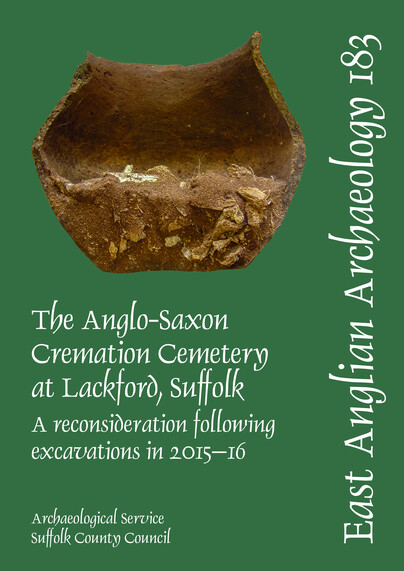
Cremation urns were discovered on Mill Heath, Lackford in the 19th century; the cemetery was located following ploughing in 1945, partially excavated in 1947–9 and published in 1951 by T.C. Lethbridge. This showed the Lackford cemetery was comparable to other large cremation cemeteries established in the 5th century in East Anglia, Lincolnshire and East Yorkshire. Over 500 burials were investigated and potentially the cemetery contained at least twice that number overall.It was believed, following Lethbridge’s account in 1951, that the cemetery lay largely below a new plantation. However occasional finds were recorded to the south and in 2015 and 2016 evidence for plough-damaged pots was noted on the field surface. These were excavated, providing the first new burials recorded at Lackford since 1949. Analysis of the 2015–16 excavations is the basis of this volume, and includes the first direct evidence for the humans and animals buried at Lackford from their cremated bone, a more reliable sample of small and fragmentary pyre and grave goods, and significant lipids data from a sample of the pots. In addition the available 1947–9 finds have been revisited and reappraised to give a more comprehensive view of the artefact assemblage and to allow comparison with other cemeteries, in particular Spong Hill in Norfolk.The archaeology of the many other contemporary and earlier cemeteries and settlements in this part of the Lark valley is examined, particularly evidence from an adjacent Roman religious site excavated in 1980–1, which is described in an appendix. Lackford remains exceptional in the area as a solely cremation cemetery, with its origins in the first half of the 5th century, close in time to the final evidence from the major late Roman settlement at Icklingham on the north side of the valley and the start of settlement at West Stow. It continued as a focus for cremation burial until at least the middle of the 6th century, alongside the many contemporary inhumation cemeteries which developed in the later 5th and 6th centuries.