Untangle the study of braids in archaeology with this blog by author Celia Elliott-Minty, a practising braider and advocate for these often overlooked textile gems. Where will the thread lead you?
By Celia Elliott-Minty, author of Braids: Definition, Recognition and Survival | 3 min read
When someone says ‘archaeology’ what do you think of? Roman villas, Greek temples, or perhaps hoards found through metal detecting. If you have an interest in textiles you may think of famous Egyptian mummies, the sock from Viking period York, UK or perhaps the Egtved Girl from Bronze Age Denmark. For the most part, organic materials such as textiles survive poorly in soil, so the chances of finding complete garments in burial settings is small. Even less likely is the survival of tiny things like braids or narrow woven bands such as the Egtved Girl’s belt.
The research for my book focussed in on braids. What’s a braid? Think of a three strand hair braid but made with more than three groups of fine threads or individual animal tail hairs. They may be flat or have a three-dimensional profile such as round or square. Some of the most complete survivors have made it through the millennia because they were attached, or adjacent, to a metal object; metal ions are biocidal so stop textile from degrading. The Galloway Hoard from south-west Scotland, found in 2014, has several textiles including braids that survived for this reason. I have a fascination for these little textile gems that deserve to be better understood, and I was very fortunate to be offered the opportunity to study them for an MPhil at Glasgow University.
Will reading this work prompt you to look out for braids or peruse unpublished reports held by your institution or local library?
All studies require good data. I began my study by identifying as many published reports as possible encompassing an area of largely northern and central Europe, from the Bronze Age to the Medieval period, to act as a much-needed baseline dataset. This was extended by case studies that I undertook on braids not previously described. I’ve also been very careful to define what a braid is and take the reader through the range of microstructures that they might meet on their own journeys. Hopefully this information is not only instructive, but also inspirational. Will reading this work prompt you to look out for braids or peruse unpublished reports held by your institution or local library?
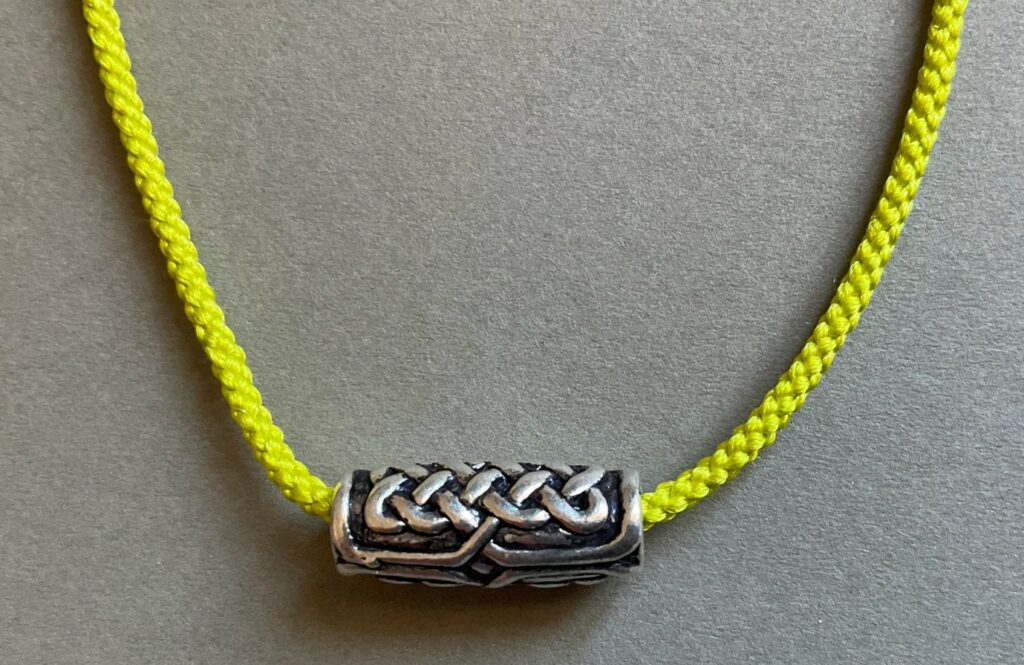
A surviving braid fragment, like other artefacts, of course raises additional questions, the most frequent of which is ‘how was it made’? This can never be definitively answered, unless you saw it being made. Fortunately, there has been some modern documentation of surviving braiding techniques from across the world, and other researchers have discovered old documents that described methods known at the time, for instance in the fifteenth century CE. Such information provides options but of course not certainty. One of my favourite sayings is “Plausible is the highest level of certainty in experimental archaeology” (Bingham and colleagues, British Archaeology, July/August 2020, page 39). I have been a practising braider for many years and have enjoyed attempting to recreate some of the braids that I have read about or personally seen as part of my case studies. I have learned a great deal in the process. This has recently led me to experiment with ways of creating braids traditionally thought of as made by two people working together, but by myself. This introduces other pertinent questions such as, even though my experimental piece may have the same microstructure as the original, would differences in tension caused by my technique make it look different?
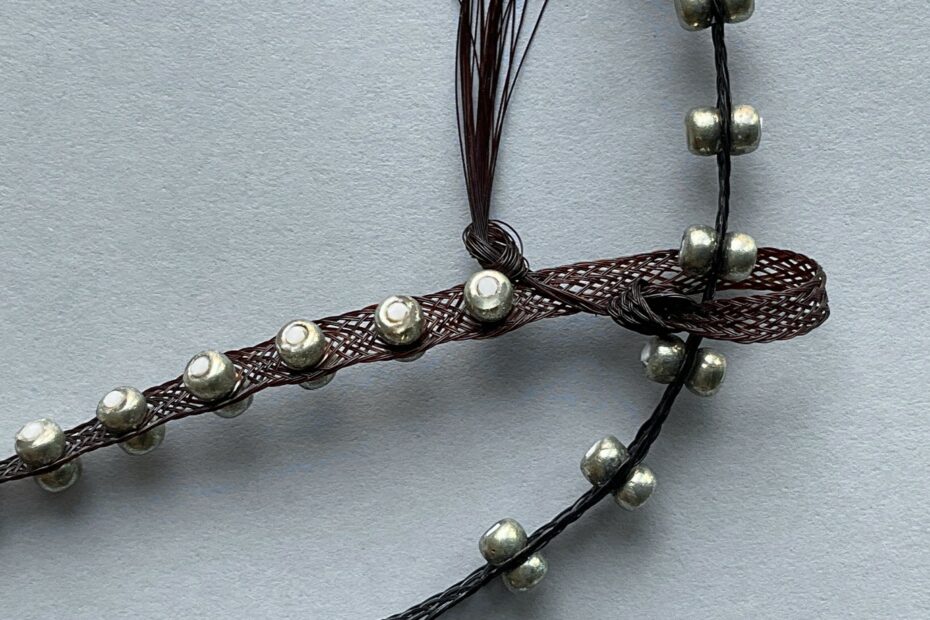
Then there is the difficulty of obtaining similar materials. The braid that is depicted on the cover of my book is my interpretation of one that I worked on from a Bronze Age cremation cist situated on Dartmoor, Devon, UK. The original was composed of cattle hair with tin studs inserted at regular intervals. My search for appropriate hair took me to a field of cows in Shropshire, UK, but via a friend, I eventually found what I needed from a Welsh Black bull in North Wales, UK. The reconstruction turned out to need two co-workers, one to braid and the other to hold the strands in place and insert each stud. The studs in my creation were made from glass beads, definitely not authentic.
To have been able to develop my interest in braiding into the serious research that this book represents has been both a unique opportunity and an honour. It would give me an even greater sense of achievement if it spawned the development of an international community of interest in archaeological and historic braids. If you have an idea of how to initiate this, I would love to hear from you. Contact me, Celia Elliott-Minty, via Facebook Messenger.
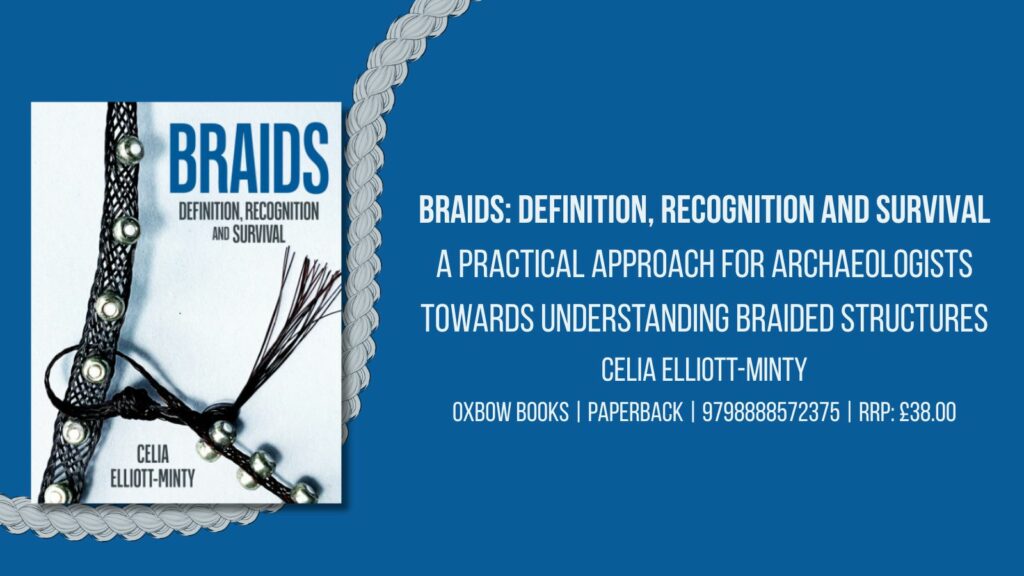
Braids: Definition, Recognition and Survival is available now from Script Books
Featured image: Part of the reconstruction of the Bronze Age braid from Dartmoor, Devon, UK, made by Celia Elliott-Minty. Image © Celia Elliott-Minty 2026, licensed via CC BY NC ND 4.0.
 Follow