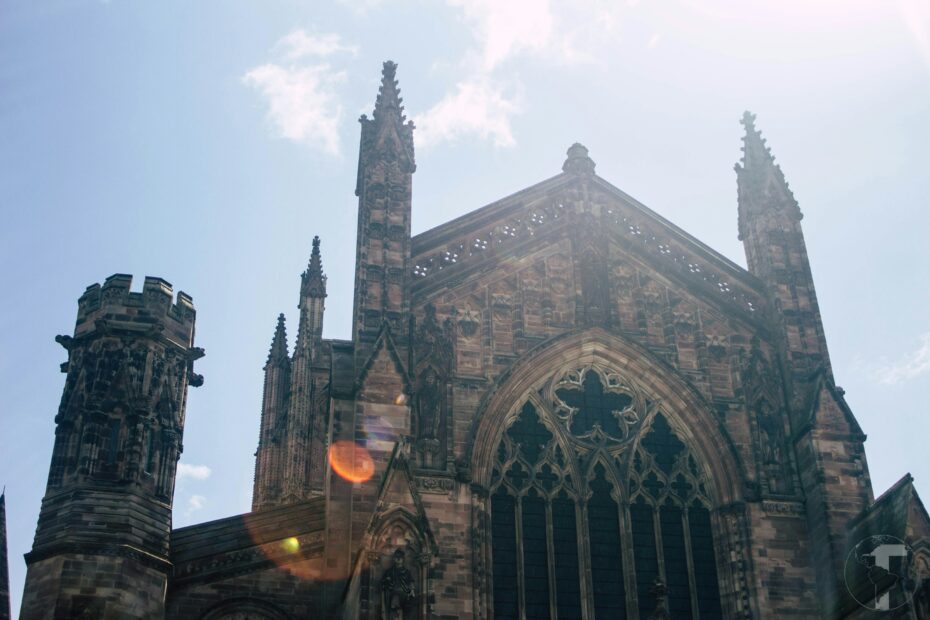
Explore insights into the health, diet and history of medieval Hereford with this blog by Derek Hurst, editor of Burials and the Black Death, which presents highlights of the discoveries from the The New Library Excavation at Hereford Cathedral.
By Derek Hurst | 3 min read
Back in 1993 an archaeological excavation at Hereford Cathedral commenced to make way for the development of a new library, which was to house the cathedral archives and a new Mappa Mundi exhibition. After much analysis, the results from this complex site have recently been published. The site was extraordinary for having deposits over 5m thick in places, and, sometimes, concentrations of finds were so great, that it was just a solid mass. Below are just some of the highlights.
Burials and the Black Death includes many new discoveries commencing with the Saxon period: 8th/9th-century buildings, a road (probably the original main north–south route through the city), and a cemetery. Unusually the cemetery includes female burials sometimes associated with iron padlocks, one possible explanation for which being that nuns were being interred, and so, intriguingly, this may imply a previously unknown aspect of cathedral history. Though, historically, the initial foundation of the cathedral is shrouded in mystery, documentary evidence shows it to have been in place at Hereford by AD 804, and this dating corresponds well with that of the earliest activity at the New Library site. In previous investigations, there has been much speculation about the Roman finds that occur in the earliest levels of Hereford sites, as was the case at the New Library site. But, so far, it looks most likely these may have arrived incidentally as part of importing salvaged building materials from a nearby site.
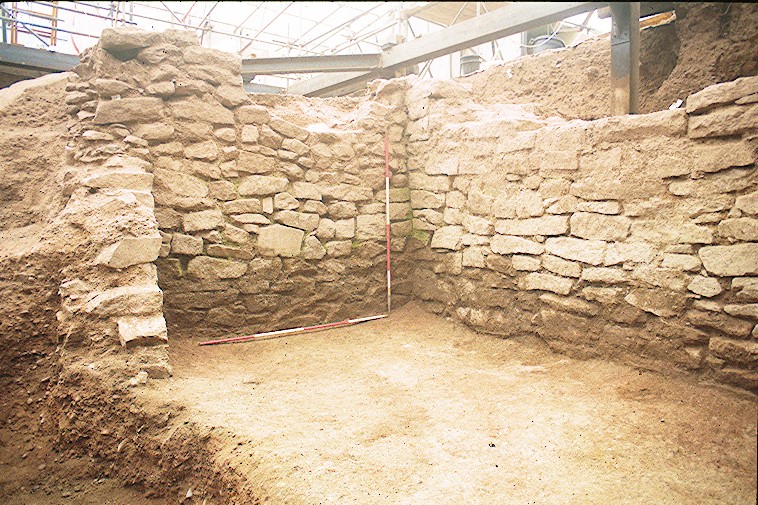
An elaborate building was erected within the site around the year 1000. This large Saxon building had several unusual features, and included a deep cellar at one end. Given its location, and that it was so well appointed, it seemed best explained as a residence of the bishop. However what was also striking about this building, was that it met a sudden and dramatic end. Subsequent dereliction of the cellar was accompanied by human cess together with dead cats and dogs, and amazingly, a sword was found lying on its floor. This pattern of evidence fits very well with the devastating attack on Hereford by the Welsh in 1055, where the scene described by medieval writers was one of devastation, with the cathedral and its clergy taking the brunt of the attack. Afterwards the footprint of this building was quarried out for aggregate, presumably with a view to a large-scale building programme, perhaps including the new Norman cathedral, with the resultant void then being infilled with a great mass of Saxon charnel.
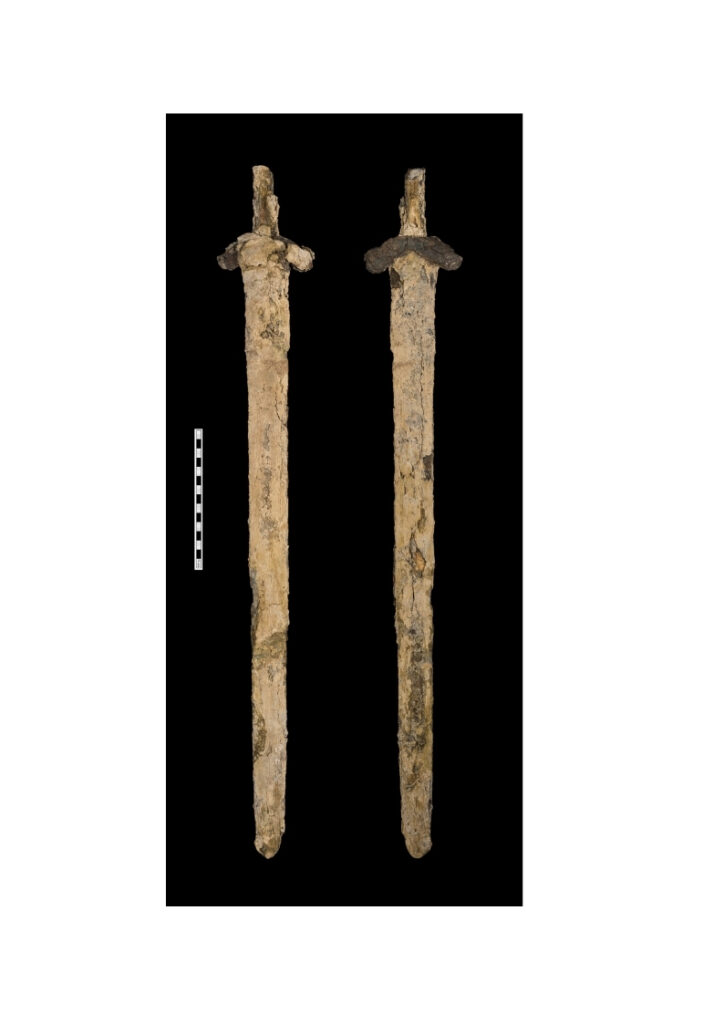
Image credit: Hereford Cathedral New Library Project
The site, as might be expected, had many medieval burials (over 1000), and this provides one of the largest assemblages of human remains of this period to be analysed. There were plenty of signs that the population was in a poor state health-wise, with, in particular, lots of tuberculosis. Exceptionally there were three large trenches stacked with bodies. Mass burial pits are the classic sign of a virulent disease having struck, and their dating is compatible with the mid-14th century, so implying the Black Death of 1349, which impacted gravely on Hereford, as elsewhere. Proof of the cause of this scene of devastation came from the teeth of some of the unfortunate casualties, where the DNA of the plague microbe, Yersinia pestis, was still found to be detectable. This featured in the first published confirmation of the presence of Y pestis in medieval archaeological remains, which was published in 2010 in the international journal PLOS Pathogens.
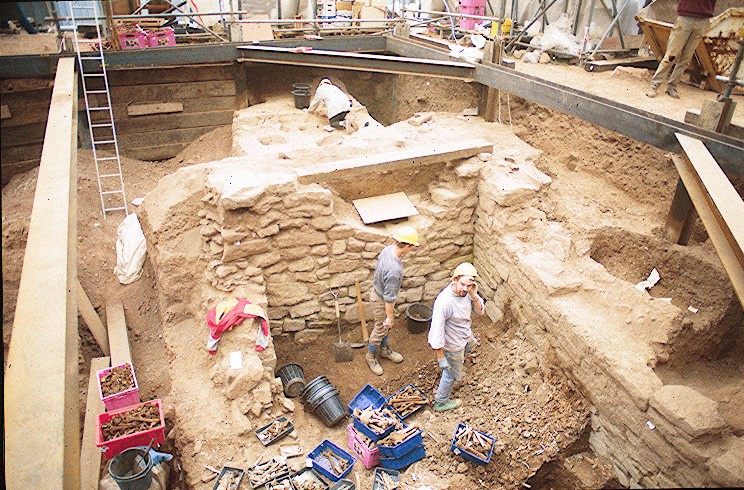
Image credit: Hereford Cathedral New Library Project
Radiocarbon dating, where focussed on the mass burial pits, initially had the unexpected outcome that there was not a good fit with the historical dating for the Black Death as the cause of mortality. However, further investigation has led to a realisation that the medieval Hereford diet must have included a high proportion of protein from fish, and notably freshwater fish, and that this has significantly affected these dating results. The fish bones from the site suggests that eels that were most common fish component of the diet, together with some herring. While this might seem like fishing for an explanation of the incompatibility of the results, a similar explanation has been used to account for why the death of Richard III (‘the king in the car park’ at Leicester) was radiocarbon dated to 30 years earlier than his historical date of death. It seems, therefore, that relatively high fish consumption, may be a complicating factor for the application of this dating method generally to this period.
The last phase of site activity saw the removal of many burials in the 19th century in order to lower the ground level, and the Cathedral Close then underwent landscaping, so it became a civic amenity space for those seeking to promenade after the fashion of that period.
References
PLOS Pathogens article https://journals.plos.org/plospathogens/article?id=10.1371/journal.ppat.1001134
C14 dating of Richard III https://le.ac.uk/richard-iii/identification/carbon-dating and https://historicengland.org.uk/images-books/publications/radiocarbon-dating-chronological-modelling/case-studies/#s52
Burials and the Black Death is available now from Script Books

Featured image credit:
Photo by Terra Strickland on Unsplash
 Follow